
Ultrasonic testing services for welds and thickness
Integrated Inspection provides precision ultrasonic testing for volumetric weld inspection and material thickness gauging. Our certified technicians deliver immediate, non-destructive results to verify structural integrity, ensure code compliance, and prevent costly downtime in the shop or the field.
Field-proven UT for welds, piping, and components
Ultrasonic testing services help you confirm internal quality without cutting, lifting X-ray barriers, or slowing the job. Integrated Inspection LLC mobilizes experienced UT technicians who work under AWS, ASME, AISC, API, MDOT, and DSA requirements—producing practical, code-based reports that keep projects moving. For broader NDT coverage, see our NDT services overview.
Need UT this week? Get rapid availability and a same-day response through our Contact page.
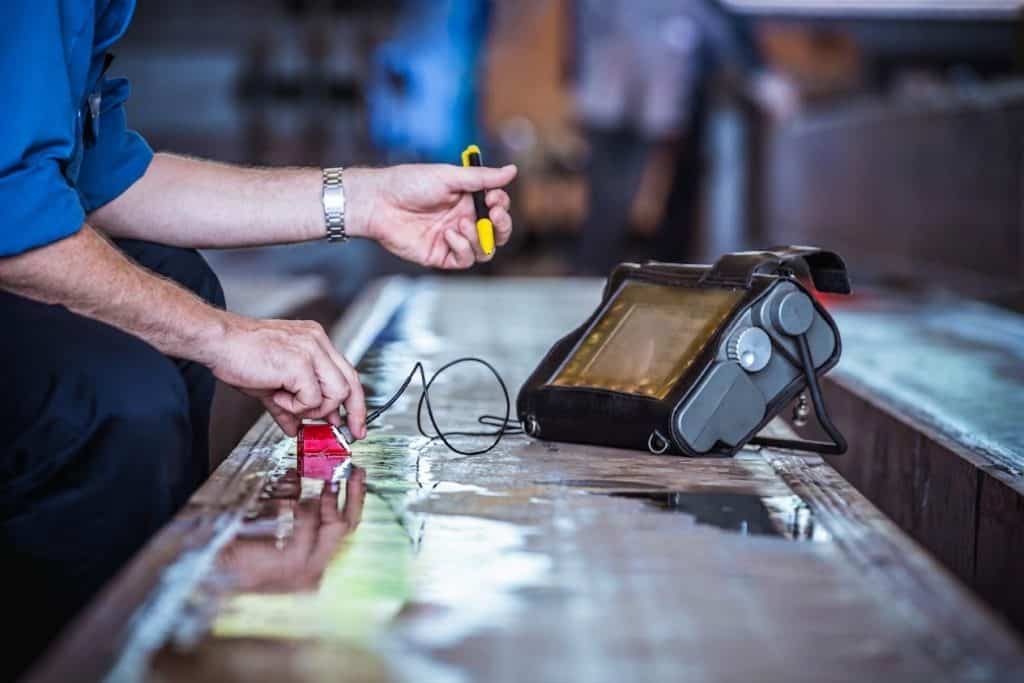
How ultrasonic testing works
UT sends high-frequency sound into the material and interprets returning echoes to find discontinuities and measure thickness. With the right procedure, couplant, and calibration blocks, ultrasonic testing can identify lack of fusion, incomplete penetration, cracks, slag, porosity clusters, lamination, and mid-wall corrosion. The method excels on carbon steel and many alloys across welds, plate, pipe, tanks, and structural members.
Why contractors choose UT
No radiation boundaries—safe for active jobsites and shifts
Immediate results with clear A-scan/B-scan indications
UT thickness measurement for baseline and in-service checks
Sensitive to planar flaws (e.g., lack of fusion, cracking)
Efficient coverage on accessible single-sided geometries
Applications: welds, piping, and structures
We apply ultrasonic weld inspection procedures for butt, groove, and fillet welds in shops and the field. Typical scopes include:
Pipeline girth welds, fittings, and tie-ins—ideal for many forms of pipeline ultrasonic inspection
Process piping circuits and elbows—corrosion/erosion screening and UT thickness measurement
Tanks, pressure vessels, and boilers—shells, nozzles, and attachments
Structural steel—full-penetration beam/column welds and laminations in plate
Heavy equipment and fabrication—critical weld joints and material verification
If radiography is still required by spec, our team also supports Radiographic (X-ray) Testing and can advise when each method fits your code and geometry.
UT thickness measurement and corrosion monitoring
Routine UT thickness measurement establishes baseline readings and monitors metal loss over time. We support grid mapping, spot checks at corrosion under insulation (CUI) locations once accessible, and turnarounds where fast, accurate readings keep schedules on track. For piping circuits and assets governed by API/ASME programs, combine UT with our Mechanical Integrity & Pipeline Inspection services to align findings with your RBI or interval plans.
Reporting deliverables
- Location-specific readings and callouts
- Calibrations, procedures, and technician qualifications
- Code references (AWS, ASME, API) aligned to your scope
- Clear acceptance statements and repair recommendations where applicable
UT vs radiography: choosing the right method
We offer a complete suite of industrial non destructive testing methods. Use this quick guide to match methods to common applications.
| When UT excels | When RT may be preferred |
|---|---|
| No radiation boundaries, minimal disruption | Complex geometries where film/digital images aid interpretation |
| Planar flaw sensitivity (e.g., lack of fusion) | Specifications that mandate radiography for certain joints |
| Rapid, on-the-spot results | Welds where permanent image records are explicitly required |
| Thickness measurement and corrosion mapping | Situations with difficult UT scanning surfaces |
Not sure which your project needs? Review our Radiographic (X-ray) Testing page or contact us to compare options against your code and schedule.
Field-ready UT for active jobsites
UT can be performed on active sites with straightforward controls: couplant management, surface prep, and access for scanning. There are no radiation barricades, making UT a practical option for shutdowns, mill outages, and bridge or roadway work coordinated with traffic control. For public works scopes, see our Bridge & DOT Inspection support.
Codes, qualifications, and reporting
Our technicians hold AWS CWI/CWE and ASNT Level II/III credentials and work under AWS, ASME, AISC, API, MDOT, and DSA requirements. Deliverables include procedures, technician certifications, calibrated instruments, and code-based acceptance criteria applied to your drawings and ITPs. We emphasize readable indications, traceable callouts, and turnaround that matches field realities.
Scheduling, coverage, and mobilization
Integrated Inspection maintains strong regional coverage across the lower half of Michigan and throughout Indiana, Ohio, and Illinois, while mobilizing nationwide as projects require. Whether you need ut weld inspection for a fabrication run, ultrasonic weld inspection on structural members, or pipeline ultrasonic inspection during a dig, we plan around your access constraints and milestones. For multi-method scopes or pre-bid planning, coordinate with our Consulting & QA/QC Support team.
Ultrasonic Testing FAQs
What can UT confirm on welds and piping?
UT can locate and size internal discontinuities such as lack of fusion, incomplete penetration, cracks, inclusions, and laminations, and it quantifies remaining wall with UT thickness measurement. On piping, it’s widely used to monitor corrosion/erosion and verify weld soundness at tie-ins, fittings, and circumferential seams.
Do you offer phased array UT?
Can UT be performed on active jobsites?
Yes. UT involves no ionizing radiation, so it can be performed alongside other work with basic controls (access, surface prep, couplant). This reduces disruption compared to RT and supports tight outage windows.
Is UT a good alternative to RT for my project?
Often. UT is excellent for planar flaws, quick results, and areas where radiation boundaries would slow work. Some specifications still require radiography on specific joints or materials—our team can review your code, drawings, and WPS/PQRs to recommend UT or RT. See Radiographic (X-ray) Testing for comparison.
Do you provide code-based reports?
Yes. We work under AWS, ASME, API, AISC, MDOT, and DSA requirements as applicable to the scope, providing procedures, calibrations, qualifications, and acceptance criteria referenced to your project documents.
What does UT service cost?
Pricing depends on scope, access, material, thickness range, part count, procedure requirements, mobilization, and documentation level. Share your drawings and spec for a fast estimate. If you need a formal quote, visit Contact. Cost range specifics needed from client.
Next steps
- Compare methods and plan ndt ut testing across your scope on our NDT services overview.
- Align piping or facility programs by pairing UT with Mechanical Integrity & Pipeline Inspection.
- Ready to schedule ultrasonic testing services? Contact our team for availability and a code-based proposal.