
Magnetic Particle Testing for Welds and Steel
Magnetic particle testing (MT) is a fast, proven method for surface and slightly sub-surface indication screening on steel components. Integrated Inspection LLC delivers mobile field coverage and in-shop support so your team gets actionable results, rapid turnaround, and documentation that keeps work moving. Explore how our magnetic particle inspection services fit your fabrication and active jobsite needs.
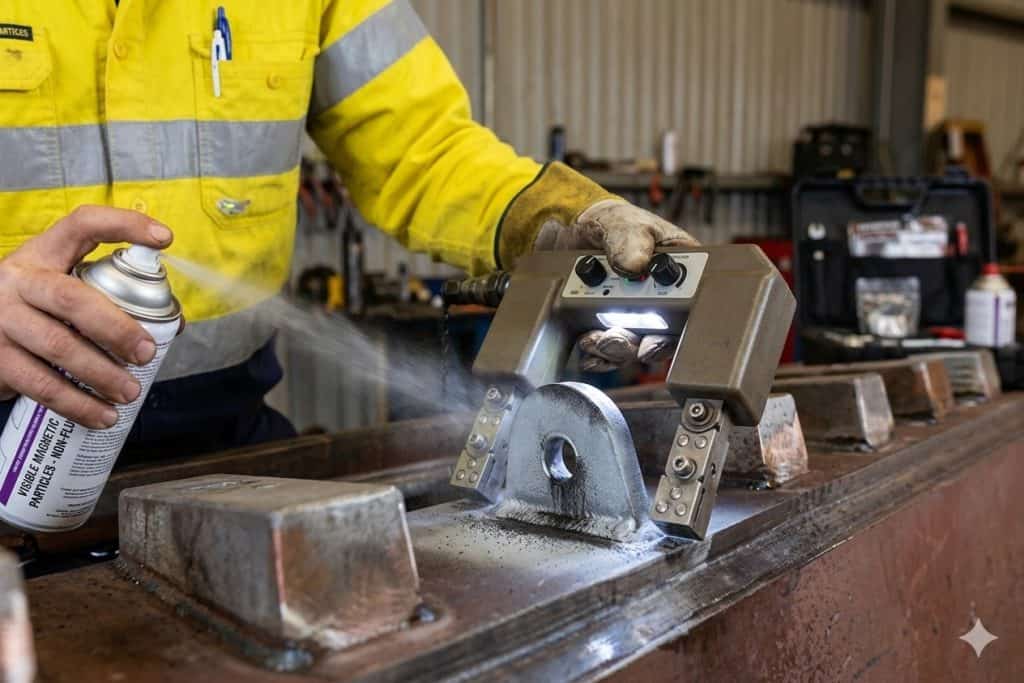
What is Magnetic Particle Testing (MT)?
Magnetic particle testing is used to reveal relevant indications associated with surface-connected flaws—ideal for efficient crack detection on welds, structural members, and other steel components. Our certified team applies MT with a practical, jobsite-focused approach so you get reliable, easy-to-interpret results and clear next steps.
- Primary use: efficient crack detection on welds and steel parts
- Deliverables: actionable calls with strong documentation aligned to project needs
- Team credentials: AWS CWI/CWE and ASNT Level II/III working under AWS, ASME, AISC, API, MDOT, and DSA requirements
If your project requires another surface method or complementary coverage, explore Dye Penetrant Testing and Visual Inspection.
Field and Shop Applications That Keep Work Moving
We support active construction sites, fabrication shops, and turnaround work where schedule certainty matters. Typical scenarios include:
Structural steel fabrication and erection welds
Piping, pressure vessel, and tank fabrication welds and attachments
Lifting lugs, rigging points, and critical load-path components
Bridge and DOT-related steel work and repairs
In-process checks and final acceptance before coating or release
Our mobile crews cover the lower half of Michigan and routinely support projects across Indiana, Ohio, and Illinois—with the ability to mobilize nationwide when the right project requires it.
Wet fluorescent vs dry powder
We offer both wet fluorescent magnetic particle and dry powder inspection. The choice depends on your part geometry, surface condition, access, lighting, and jobsite constraints. Our team will recommend the most practical method for your environment and inspection goals.
Wet fluorescent magnetic particle
- Suited for controlled conditions and fine indication visibility
- Supports efficient scanning and photo documentation where permitted
Dry powder inspection
- Useful in many field conditions and on a broad range of steel surfaces
- Straightforward setup for fast, repeatable checks on production and repair welds
Process, acceptance, and reporting
Our approach to mag particle inspection emphasizes clarity and coordination with your team:
- Scope alignment: confirm materials, weld categories, coverage areas, and acceptance criteria per your project requirements
- Execution: perform magnetic particle testing method(s) best suited to the work and environment
- Interpretation: review relevant indications and communicate practical next steps for your field or shop team
- Documentation: deliver clear, organized reporting with traceability and supporting details appropriate to the scope
When your project needs complementary coverage, we can coordinate with Ultrasonic Testing, Radiographic (X-ray) Testing, and Visual Inspection to streamline planning and minimize downtime.
When MT is the right choice
Use MT when you want:
- Efficient screening for surface-connected issues at weld toes, heat-affected zones, and attachments
- Practical, on-the-spot feedback that supports repair decisions and keeps installation or fabrication on schedule
- A method well-suited to steel structures, piping spools, and shop-fabricated components
Consider alternatives alongside MT when your scope calls for different coverage:
- Need volumetric insight or thickness data? See Ultrasonic Testing.
- Need radiographic images for select welds or procedures? Explore Radiographic (X-ray) Testing.
- Need a surface method on non-magnetic materials or certain finishes? Review Dye Penetrant Testing.
Frequently asked questions
When is MT the right method?
Choose MT for fast crack detection on steel welds and components where surface-connected indications are the primary concern. If your scope needs additional coverage, we can coordinate UT, RT, PT, or enhanced Visual Inspection as appropriate to the job.
What materials can be tested with MT?
We commonly apply MT to steel components across structural, piping, pressure vessel, tank, and related fabrication work. If you have a specific material or finish in question, share details with our team and we’ll confirm suitability.
Do you offer field magnetic particle testing?
Yes. We provide mobile field support across the lower half of Michigan and regularly work in Indiana, Ohio, and Illinois—with the ability to mobilize nationwide for the right projects. For broader capabilities, see Non-Destructive Testing (NDT) Services.
What is the difference between wet fluorescent and dry powder MT?
Both are effective approaches within magnetic particle testing. We recommend wet fluorescent magnetic particle or dry powder inspection based on your surface condition, access, lighting, and jobsite constraints. We’ll help you select the most practical method for your scope.
Do you provide formal reports?
Yes. We deliver strong documentation aligned to project and code requirements, with clear results and traceability. Tell us what your project needs and we’ll match the format.
How quickly can you mobilize?
We prioritize rapid turnaround and schedule coordination. Provide your location, scope, and timing and we’ll confirm availability and the best path forward. Start the conversation via Contact.
Get a quote or schedule
Ready to plan mpi weld inspection or broader mag particle inspection on your next job? Tell us about your scope, timeline, and acceptance criteria—we’ll recommend the right approach and deliver practical coverage that keeps your work on schedule.
- Start now: Request an MT quote
- Explore related methods: Dye Penetrant Testing and Visual Inspection