
Dye Penetrant Testing for Reliable Surface Crack Detection
Dye penetrant testing (PT) is a fast, dependable way to reveal surface‑breaking indications on ferrous and non‑ferrous components. As part of our mobile inspection toolkit, PT helps keep fabrication, repair, and in‑service projects moving with clear, code‑aligned results.
Need broader coverage across methods?
Ready to move forward?
What is Dye Penetrant Testing (PT)?
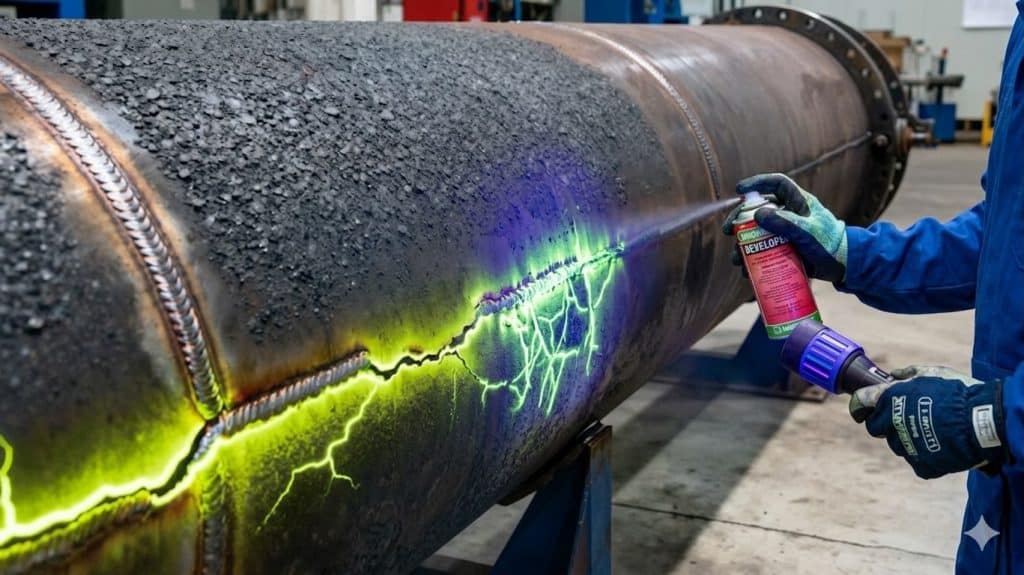
Dye penetrant testing—also called liquid penetrant testing—uses a low‑viscosity dye to wick into surface‑breaking discontinuities. After dwell and developer application, open‑to‑surface indications become visible for evaluation by a qualified inspector. PT is ideal for surface crack testing on welds, castings, and machined parts where quick, sensitive screening is needed.
Key advantages:
Sensitive to very fine, surface‑connected defects
Portable, economical, and fast to deploy in the shop or field
Works well on complex geometries where visual cues alone can be missed
PT in Fabrication, Repair, and In-Service
We are a third-party partner focused on helping contractors, fabricators, and project owners meet code requirements with minimal disruption to schedule. From structural steel and pipeline work to tanks, pressure vessels, and shop fabrication, we bring the right method at the right moment—so you get accurate results and clear next steps.
PT fits naturally at multiple project stages:
PT fits naturally at multiple project stages:
- New fabrication: Use PT weld inspection at fit‑up hold points, after root/finish passes, or prior to coating to verify surface quality before proceeding.
- Repairs: Confirm the removal of defects and validate repaired areas before final acceptance.
- In‑service checks: Investigate suspected leak paths or stress‑prone details where surface‑breaking flaws are a concern.
When PT is the right choice
When PT is the right choice
- You need fast, high‑sensitivity screening for open‑to‑surface flaws
- The material and surface finish are compatible with PT chemistry and cleanup
- You want a code‑aligned record to close out a punch list or hold point
Looking for a complementary method for magnetic materials or subsurface concerns? See magnetic particle testing and pair PT with visual inspection for complete surface coverage.
Visible vs Fluorescent Methods
We provide dye penetrant inspection services in both visible and fluorescent modes to match project specifications and viewing conditions:
Visible (color‑contrast): Red dye under white light for fast, practical screening.
Fluorescent penetrant inspection: Enhanced sensitivity using UV‑A illumination when specifications or environment call for maximum visibility.
If your written practice, drawing notes, or code reference requires a specific penetrant family or sensitivity level, let us know and we will align the procedure and documentation accordingly.
What PT Finds and Its Limits
PT excels at revealing surface‑connected flaws, including fine cracks and open discontinuities. Because it relies on capillary action into surface openings, PT is not intended for subsurface indications. If you suspect discontinuities below the surface or in ferromagnetic steel, consider magnetic particle testing or other methods from our NDT services portfolio.
- Strengths: Surface crack testing with high sensitivity and fast turnaround
- Limitations: Not for subsurface defects; requires clean, non‑porous surfaces
Codes, Acceptance Criteria, and Reporting
Our inspectors work to the codes and standards your project runs under, including AWS, ASME, AISC, API, MDOT, and DSA requirements noted in your specifications. You receive straightforward, code‑based reports suitable for closeout, audits, and turnover packages. If your contract requires specific procedures, hold points, or witness requirements, we will align our PT weld inspection steps and documentation to match.
Scheduling, Mobilization, and Safety
Integrated Inspection LLC provides mobile field support with strong regional coverage across the lower half of Michigan and throughout Indiana, Ohio, and Illinois—and we regularly mobilize nationwide as projects require. We maintain DOT drug/alcohol testing compliance, OSHA 30, and radiation safety practices consistent with our broader NDT operations. Tell us your timeline and site conditions, and we will coordinate a practical PT setup that keeps work moving.
Have a time‑sensitive need? Contact us for rapid scheduling options.
PT Process and Surface Preparation
While specific parameters follow the governing code and project requirements, a typical PT workflow includes:
Pre‑cleaning and preparation
- Remove contaminants that could mask or trap penetrant
- Confirm surface condition and accessibility
Penetrant application and dwell
- Apply the chosen visible or fluorescent penetrant uniformly
- Allow dwell per the approved procedure
Removal and developer
- Carefully remove excess penetrant
- Apply developer to draw out penetrant from surface openings
Inspection and evaluation
- Evaluate indications under appropriate lighting (white or UV‑A)
- Classify and record indications per acceptance criteria
Post‑cleaning and documentation
- Clean the part as required
- Issue a clear, code‑aligned PT report
Frequently Asked Questions
When is PT the right choice?
Choose PT when you need a fast, sensitive method to reveal surface‑breaking flaws on accessible, non‑porous surfaces—especially for weld profiles, castings, and machined features before coating or service.
Do you perform fluorescent penetrant testing?
Yes. We provide fluorescent penetrant inspection when specifications or conditions call for enhanced contrast under UV‑A lighting. Share your project requirements so we can align the procedure and reporting.
What surfaces or materials can you test?
PT is intended for non‑porous surfaces. Share your material, finish, and cleanliness requirements, and our team will confirm compatibility and the most effective approach for your part geometry and environment.
How is surface preparation handled?
We follow project and code requirements for cleaning and preparation to ensure reliable results, then restore the area per site needs. If special cleaning restrictions apply, please advise so we can plan accordingly.
Do you provide code-based reports?
Yes. Deliverables include clear, code‑aligned reporting that matches your spec and contract documentation needs.
How quickly can PT be scheduled?
We prioritize rapid turnaround with mobile crews. Provide your location, scope, and timeline, and we’ll propose the earliest available window.
Plan your NDT: next steps
Ready to book dye penetrant testing or build PT into your next inspection plan? Request a PT quote now. No spam—just a fast, helpful response.